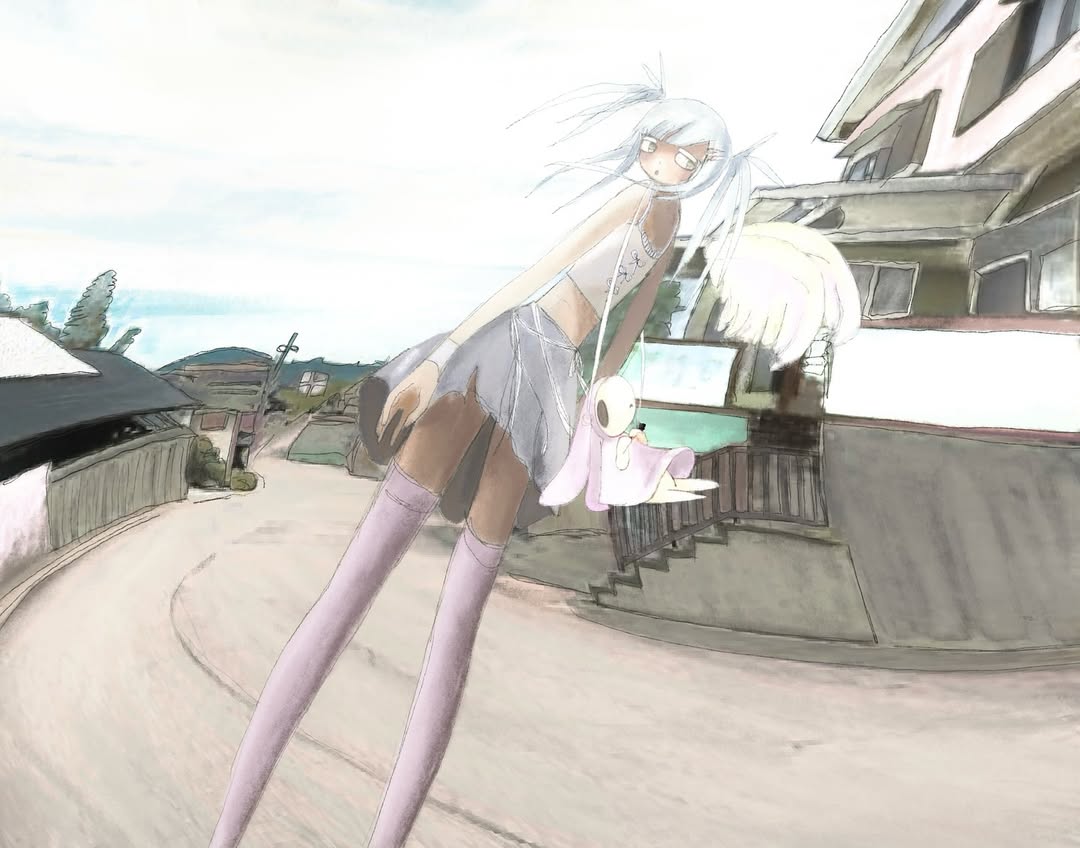
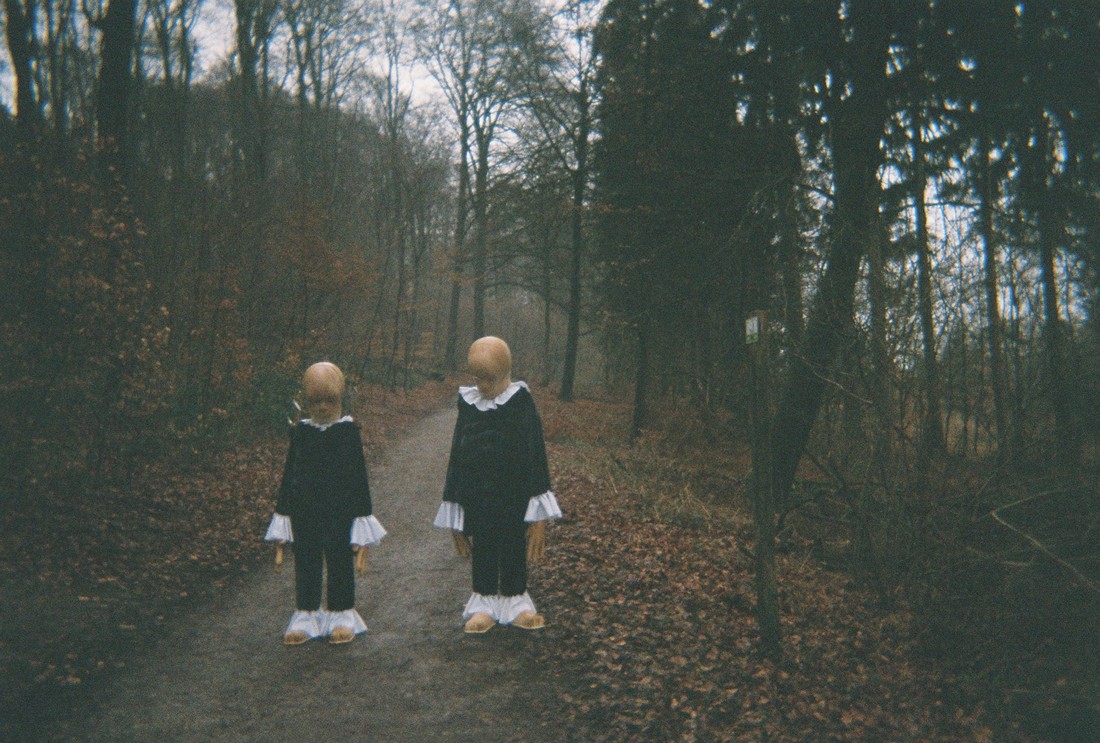
fragment_doll + denpa_doll | OFFSITE ORIGINS: a constitutive poetics of offsite and post-offsite practice
image: coyvboy
There is a standard account of how offsite art practice came to exist: it runs through post-internet sculpture, through the dual-site format and the critical infrastructure of concepts such as New Materialism and Object Oriented Ontology. In this account, offsite practice emerges from post-internet's encounter with institutional critique: documentation replaces the work, the site becomes the staging ground for the image and the gallery cedes primacy to the feed. Such an account is radically incomplete: it describes the moment at which offsite practice became legible and mistakes legibility for origin.
The canon produced by the standard account is English-language, institutionally adjacent and centred on New York, London, Berlin; this is strangely regressive in a context where the practices in question are definitionally online and logistically distributed. One of the structural transformations networked practice was supposed to accomplish was the end of the city and the institution as mandatory aggregation point, yet the canonical account reconstitutes the same cartography in digital form, repeating the same founding figures and critical infrastructure to which everything remains supposedly bound. The map of distributed online practice looks like the map of any contemporary art practice with a browser window open on it.
This essay proposes a corrected genealogy. The traditions it centres (the chata/cottage exhibition complex across Eastern Europe, the Japanese practice of butai tanbou, EGL and Visual Kei archive culture, underground practices in firewalled Asian cities, the early digital commons) are not precursors to the practice that post-internet discourse describes, they are constitutive of it: generating the methods, the aesthetic sensibilities, the network structures, and the philosophical positions that critical discourse later theorised from the outside and adopted as found materials.
This is a recognisable pattern in canon formation and it produces a qualitative change in the material it handles. The danger is not misreading but erasure of provenance: the severing of the fragment from the Geist that formed it. Geist arises through specific conditions and inheritances, bound irreducibly to finitude; its severance constitutes a fundamental deficit in the way post-offsite practice is recieved. The canon may carry the same words but it cannot enclose the spirit.
what images do ↓
It is necessary to establish what images do in networked circulation because the image is the foundation on which post-offsite practice rests, and this account differs from both the institutional understanding of documentation and the post-internet understanding of the image-object.
Around 2012 the website dawsonscreek.info posted an image macro: IMAGES ARE WORTHLESS. MARKET VALUE IS ABOUT SCARCITY AND IMAGES ARE NOT SCARCE. ENDLESS SCREENS, EAGER TO DISPLAY WHATEVER ENDLESS CONTENT. A subsequent curatorial reflection on this names two primary truths: "the fact of overabundance levelling traditional forms of value, and the aesthetic seeping out from the work (maybe surpassing it entirely), bleeding into the oils between my finger and the screen, re-congealing as an image experienced asynchronously on thousands of private screens with millions of possible contexts, access points, and virtual meanings. Likewise the value of standard institutional curation has altered as complex forms of image parsing have become entirely commonplace; we create, collect, index, archive, and process images in highly nuanced ways".1
This is an account of what the image actually does as well as a description of the post-internet condition. The image is not a copy of something that exists more fully elsewhere. It is a compression: an encoding of a particular reality that, when circulated through the network, opens according to the conditions of each reception. As one curatorial statement puts it: "images are compressions; they open and close, they're coded and re-encoded through saves, shares, and circulation; as such, they're capable of carrying layers upon layers of immediately sensible holographic knowledge."2 Each asynchronous reception of the same image across thousands of private screens is a distinct opening of the same fixed compression; the image resolves according to the capacity of the receiver.
This runs parallel with the chata exhibition,3 where conditions that made institutional exhibition impossible became generative constraints that produced the practice's formal qualities. The networked image era generates its constraint at the level of value: overabundance has levelled traditional scarcity-based value, rendering institutional imprimatur insufficient as a quality criterion. Freedom from the value logic that organises institutional practice is the operative condition of the work's ecstasy.
the chata principle ↓
The canonical art-historical term is "offsite." The actual tradition it names draws from dozens of words, none of which are English; each bears specific cultural and political histories that the English terms erase.
In Ukraine: dacha. Dacha names the typically wooden rural house where citizens retreated from collective surveillance into hermetic privacy. The dacha became a site of creative activity for reasons of necessity, providing distance from conditions in which official exhibition was ideologically controlled and unofficial exhibition carried political risks.4 At the dacha, a community of practitioners could gather and the specific poetics of a given temporary space would develop accordingly. In Russia, the Moscow Conceptualists conducted participatory performances in forests and fields, rarely documented and marked by the act of gathering rather than the production of objects;5 their aesthetics were generated by the encounter between artistic vision and the conditions of necessary evasion. The dacha shows operated as the informal circulation of work through trusted networks and through the physical gathering.
In Czechoslovakia, the same structural requirement produced a different word and a distinct history. Chata and chalupa (cabin and countryside house) together constituted chataření, the Czech mass practice of weekend retreat that reached fever pitch after the Prague Spring: the city emptied every Friday afternoon into private and unsorted spaces, prefigured by the trampování (tramping) movement, which built forest settlements as alternative spaces for gathering and music-making.6
The chataření impulse continued for generations and found a new register once it met the internet. Exhibitions like Invigorating Solstice Compound or DE SORTE QUE PLUS JAMAIS UN INSTANT SOIT MAGIQUE staged at Prague's Olšany Cemetery in 2010 by Slovak artist Nik Timková7 show the chata principle applied through distinctly net-native sensibility: the site is chosen for its inherent content and work is understood primarily as what the site and the image between them produce.
The Prague collective A.M.180 formed in 2003 and operated independent multifunctional cultural spaces in the city,8 arranging exhibitions and screenings that bridged local contemporary art scenes and internet visual culture. Their reach extended through AMDISCS,9 one of the primary distribution nodes for early vaporwave and net-adjacent experimental music that released Coolmemoryz, AyGeeTee, and ESPRIT 空想 at the moment the aesthetic was forming. Since 2009, their Creepy Teepee festival has converged on multiple sites (a monastery, a Jesuit college yard, a park) to build a yearly "autonomous city within a city ... [through the] everlasting and irrational love of arts and music." The mediaeval silver-mining town of Kutná Hora with its bone-festooned Sedlec Ossuary functions as constitutive content, though the event could take place anywhere with sufficient space and atmospheric density.10 Bladee, Ecco2k and Whitearmor performed at Creepy Teepee in 2017 and 2019,11 years before the group gained mainstream recognition; they arrived through shared frequency rather than industry channels.
We propose the chata principle as an umbrella term for the use of unsorted or obscured gathering sites as a space of hermetic exhibition-making under conditions of institutional hostility. Across Hungary: nyaraló. Across Poland: domek letniskowy. Across Finland: mökki. Across the Baltic states: suvila, sēta. The early post-offsite network operated through encounters between practitioners already tending toward the same frequency: the willingness to treat an ephemeral material action as devotional. This is how the chata principle actually propagates; someone encounters the gesture, understands immediately what it's doing, and begins to make work from that understanding.
One network that cohered is visible in The Days Are Just Packed,12 a two-day offsite show curated by Ece Cangüden and Marian Luft on Heybeliada: a car-free island in the Sea of Marmara that is accessible only by ferry from Istanbul. From the show's poem: "The physical manifestation of our online beings / as a fluid leaking out of the digital purgatory... Dear post-social primates / you are the territory / even if you are far / you can be close.". A distributed gathering cohered simultaneously around Rhizome Parking Garage (co-founded by Ian Bruner and Noah Travis Phillips), which prompted artists to stage exhibitions through a network of parking garages;13 each a universal non-site. This is the chata principle applied to the most ubiquitous of secondary infrastructures across numerous countries. It surfaces too on the Dalmatian coast in Tea and Marta Strazicic's Burned Forest Black Metal (Mosor, Croatia, 2014): a gathering of costumed figures, internet-sourced images, and improvised installations on ground blackened by summer wildfire.14 The ash and scorched terrain functioned somewhere between charged setting and active medium; the site was chosen because it was unsorted and strange; its destiny was to extend into the digital space.
The underground rave scenes of the 1980s and 1990s operated on similar principles, forming what Hakim Bey would call Temporary Autonomous Zones: the warehouse and the empty field were spaces seized for a short period of intensity and closed before they could be shut down or recuperated.15 Distinctive costuming and swapped kandi signaled initiation; the night ends and the rave disperses back into the network. Projects like Omsk Social Club extended this logic directly into durational collective practices such as Real Game Play, built from what one member called "the large-scale, ritualistic and ceremonial" practices16 of their own raving years.
Bey further theorized an enduring network of autonomous zones,17 writing from Dreamtime Village, an intentional community founded in 1991 by artists mIEKAL aND and Lyx Ish in West Lima, Wisconsin. Dreamtime Village operates simultaneously as a physical home and a network of friends and collaborators.18 Its philosophy is rooted in the dual practice of "hyperwilderness" and "hyperculture", integrating permaculture with experimental publishing to enact what they term "creative solutions to environmental problems." Among these were early Macintosh-based interactive hypermedia projects like the Joglars/crossmedia beliefware, "a bird-operated time machine housed in a 25-foot blue glass tower", Ish’s work with gourds, and visual chapbooks and audio art distributed via Xexoxial Editions through both the browser and the mail. Here the rural commune is the necessary base for the distributed network; the physical gathering and the shared land make the hypermedia practice possible.
Fluxus scored these methods early: the event score was the primary form and the work existed primarily in its documentation and re-enactment. Distribution was routed through private and postal networks in the form of mail-art and international correspondences; the conventional exhibition was optional and Maciunas's anti-institutional conceptualism was grounded as an operational method.
The chata principle is inherited by the digitally expanded hearth; the hermetic gathering site becomes available as archive. Mariyasha's Cabin (2022) is described as "a two-room cabin connected to the internet, open for exhibitions monthly," and "a collection of save~states irl".19 Its theology is stated plainly: "You can't exit the internet to reality (...) screens are portals thru the metaphysical, and everything is real and I love you." The internet is the cabin's extension into the permanent present, which is where the gathering has always been trying to lead us.
the firewall underground ↓
The chata principle does not require the countryside. It follows the available margin: wherever necessity opens a gap that practice can occupy. In 2000s Shanghai, this meant descending into the city's neglected spaces: the disused storefront, the rooftop after the venue below was shut down. The urban underground is the chata turned inside-out: it is centripetal where the chata is centrifugal, burrowing into the city's own forgotten infrastructure.
Genome 6.66Mbp, founded in 2016 by Tavi Lee and Kilo Vee, captured this idea in a concentrated form. Shelter, an iconic Shanghai club that was housed in a converted air-raid bunker, closed on New Year's Eve 2016 and suddenly the nascent experimental scene lost its home. Genome responded by spinning the community into rotation. They moved from venue to venue and built their network through frequency-recognition, cold-messaging international producers with tiny followings, as Tavi Lee put it: "online friends or producers I liked that I met/found out about and contacted on SoundCloud".20 Aesthetic and network were inseperable as both were generated from the condition of operating inside a limited system. The same spirit ran through Basement6, a raw concrete bunker-turned-venue on Huashan Lu co-founded by Katy Roseland. Its 'richest currency' was the network itself: the ability to route an artist or collaborator through a scene that couldn’t be discovered by normal channels.21 'Entering Basement6 is always like the first time, like walking into an open grave just as a circus is about to begin.'
These practices produced a particular and generative visual culture; its defining motifs moved at the pace of rapidly proliferating micro-aesthetics and responded instinctively to scroll. The bunker's concrete and the wet market's neon were active materials that shaped formal decisions; the wildly DIY construction of improvised fashion and market hyperabundance produced specific visual qualities through necessity. The site's constitutive charge was forced through the narrow aperture of screen resolution and circulation speed. What emerged was a new, lightning-in-a-bottle aesthetic register that was more formally impactful than either the site or the screen alone could have produced.
There is a shared economic logic: turning cheap or zero-rent marginal spaces into sites of cultural intensity. A former yī kuài store, a wet market, a wartime bunker or a disused office; spaces that are available because capital has moved on (or has not yet arrived, or is held at bay by bureaucratic opacity) becomes the site where a different kind of value accumulates. The poetics emerge from the constraint; the city’s outer firewall and its internal tier system created pressures that practitioners responded to.
Such practitioners arrived at the bunker or the wet market with a screen-saturated eye that recognized these physical sites as environments capable of matching the density and texture they needed. This was further codified through post-production conventions that functioned as essential formal grafts: where traditional art documentation strives for neutral transparency, these edits acted upon the viscosity of the image and aligned the raw textures of the site with the produced semiotics of the post. The essential thing is the feedback loop between these pressures: the aesthetic that emerges from the site and the materials is amplified and mutated by the circulation logic; more practitioners respond and their work develops the aesthetic further; it circulates further still. This is how visual culture is produced by specific interactions whose formal qualities are constitutive of what later becomes mainstream visual language.
Shanzhai Lyric, initiated in 2015 by Ming Lin and Alexandra Tatarsky, takes its name from the Chinese for 'mountain hamlet': the outlaw stockpile beyond government reach. Their archive of over 400 poetry-garments sourced from informal markets across Asia and its diaspora and shared memetically through social media makes the principle literal: the bootleg garment is already a collectively authored object, carrying fragments of English accumulated through anonymous labour and accidental translation - 'DREPM THE WOELD, NOT A FOHOWER, Welcome to The Recession Forecas Interest Rates Financial Crisis Capital Investment Anxiety Deepens' - that no author intended as poetry but functions as poetry anyway.22 The same itinerant logic runs through Elaine W. Ho's Display Distribute (Hong Kong, 2015–ongoing): a roving shop and publishing platform investigating bottom-up organisation amidst global trade, moving through margins without fixed ground.23
In 2018, the exhibition WET by Malaysia-based curatorial project Haunt Collective was staged simultaneously at a local wet market and a converted bus depot operating as gallery space. The group exhibition invited Monia Ben Hamouda, TARWUK, Brenna Murphy, Martin Kohout, Bora Akinciturk: practitioners central to the post-internet canonical lineage; the works were produced through the wet market's own logistics: blueprints sent via email, local printing, rough approximations from available materials, essentially comprising shanzhai artifacts.24 When the exhibition closed the works disintegrated back into the market. The accompanying publication proposed a practice of staying with the E Gui, the Hungry Ghost, without being subsumed by it.
House-D12 (Airport Biennale 'Extreme Mix', Guangzhou, 2019) was a visual installation by Wang Newone with sound design by Felicita inside a century-old Lingnan village house in Fenghe Village, Baiyun District,25 scheduled for demolition by local government after the exhibition closed: both the no-tier condition and the chata principle in concentrated form. Suspended between nightclub ritual and funeral rite, large-scale silhouettes in subcultural fashion were cast in atmospheric light behind sheer curtaining, spiked sculptures rested against salvaged brocade lace, incense burned in the ancestral shrine outside. The site pressed into every aesthetic decision and the work simply held the frequency until the building came down.
The DEADSTOCK programme (死寂工作室, 2019-2020) staged hyperstitional raves in no-tier Chinese cities and fashion editorials assembled from deadstocked garments on industrial rooftops. Its core concept named the logistics-aesthetic condition: 'every trend is already deadstocked: infinite microgenres are minted from the constant recombination of prior forms and industry supplies products at an even faster pace than the desires they service.'26 Alongside this is a taxonomy of "No-Tier aesthetics": the factory towns and development zones existing outside China's city-tier ranking system entirely while serving as its production base. A hyperstition methodology of No-Tier aesthetics was included in the curatorial brief: 'producing a particular shift merely by spreading the idea that it has already happened'.
This is crystallized in Cellophane Mother Memory (Corpsesimulacrum, Tsim Sha Tsui, 2019):27 "You're hovering in the eye of a knockoff Real with cheap HD edges: the neon tube lights are made in Shenzhou or Guangdong. Split up and sold again, installed in fixtures in endlessly subdivided rooms in the endlessly micro-dividing chain of logistics. You're always calculating your profit: lovemaxxing MOQ to retail but at the end of the day all of the flows are residue." This writing is produced from inside the logistics chain and thinking in its units because those are the actual conditions of practice. The knockoff Real is what the original reveals itself to be when you see it in the right lighting.
Corpsesimulacrum operated through a practice called 装B (zhuāng bì),28 the art of infiltrating upscale spaces under false pretences, producing photographs that circulate as if the infiltration were real. 装B names something broader in Chinese internet culture: to perform class mobility convincingly enough that the performance produces its own reality. Corpsesimulacrum's use of it was deliberate; entering spaces, documenting the occupation and releasing the images into networks that understand what is being done. This modality was converged upon synchronously by Amalia Ulman's Excellences and Perfections, a five-month scripted performance in which Ulman photographed herself in hotels, restaurants, and luxury spaces she had infiltrated. Both the Chinese underground's infiltration practice and Ulman's project arrived at the same formal operation from different conditions: what Ulman staged as institutional critique, 装B practitioners perform as distributed practice generating constitutive poetics from necessity.
butaitanbou: stage exploration ↓
Butaitanbou (舞台探訪, "stage exploration") is an investigative and photographic practice with a genealogy that predates the material it is now applied to by several centuries.
The practice divides into two related activities. Seichi junrei (聖地巡礼, "pilgrimage to sacred places") is the broader category: the physical act of travelling to a real-world location that served as the setting or background source for a scene in anime, manga, or visual novel.29 Butaitanbou is more specific: the practice of identifying locations without pre-existing guides or maps, using only the visual evidence present in the animated frame; then travelling to the location and producing a photograph precisely matching the original cut. The practitioner who first identifies and documents a location is called a pioneer (先駆者) within the community.
The operation this produces is a devotional superimposition: the image and the site are held in the same frame; the fictional world and the real world overlap at a specific coordinate. The landscape is a physical save slot: a location in the real world that stores a narrative state from a fictional one, to which the practitioner returns in order to reload the experience. The community maintains databases of save slots cross-referenced to the specific cuts from which they were identified, annotated with atmospheric details and access considerations.
The Please Teacher! anime (2002) prompted pilgrimages to Lake Kizaki in Omachi City, Nagano Prefecture; local residents became involved in community beautification alongside the fan community. The first formal Butaitanbou Summit was held at Lake Kizaki on 12 April 2008.30 Lucky Star (2007) sent large numbers of practitioners to Washinomiya Shrine in Saitama Prefecture (one of the oldest Shintō shrines in the Kantō region,31 patronised by the Tokugawa shogunate) where the anime's characters serve as miko. The head of the shrine expressed concern that visitors were "worshipping deities other than the shrine's own." Higurashi no Naku Koro ni's multiple-chapter structure is set in Hinamizawa, a village directly modelled on Shirakawa, the mountain hamlet in Gifu Prefecture. Butaitanbou-sha have documented the superimpositions between Hinamizawa's animated streets and Shirakawa's physical ones across all of the series' narrative iterations: the same locations mapped across multiple incompatible timelines with each photographic documentation adding another layer to the archive.
Okamoto explicitly warns that commercialisation and institutionalisation risk diluting the "mystery solving and hacking elements" that make butai tanbou attractive to its practitioners. He characterises the Anime Tourism Association (founded in 2016 to link anime works with regional tourism revenue) as "an attempt to oppose the spontaneity of fans like never before." The institutional appropriation that attached to the practise followed a typical tri-phase structure: the pioneer community develops the practice through shared frequency and devotional intensity; it achieves visibility through specific high-profile instances; institutions arrive to systematise what they did not initiate. The save slot becomes a waypoint on an official tour route.
Butaitanbou's art-historical genealogy runs even deeper than the post-war anime that provides its immediate material. The tradition of meisho (名所, "famous places") and meisho-e (名所絵, "pictures of famous places") extends through the Edo period and earlier: woodblock illustrated guidebooks, then prints, then the great series of Hiroshige, One Hundred Famous Views of Edo, Sixty-nine Stations of the Kisokaido Highway, in which the artist travels to specific sites and produces the image that encodes the place's emotional and literary associations for circulation.32 The uta-makura tradition too: place-names embedded in classical poetry carry specific emotional resonances developed through centuries of use, so that naming the place names the feeling, and travelling to the place is travelling into a palimpsest of accumulated literary inscription. Bashō's Oku no Hosomichi (1694) is the supreme instance: a journey whose entire logic is a communion with the physical landscape that embeds the literary one.
The practice extends readily into the landscape of video games built from real locations. Bloodborne's Yharnam, drawing heavily on Central European Gothic architecture, has generated its own pilgrimage community: players identifying specific bridges and attractions in Prague and other Bohemian cities as the source coordinates for the game's environments, travelling there to produce the superimposition; often including cosplay and other elaborations. The save slot requires only a fictional world dense enough with real-world derivation that the practitioner can reverse the process of its construction.
Butaitanbou is this established tradition applied to the contemporary fictional landscape. In each instance the practitioner travels to inhabit the fictional world that occupies real coordinates, produces the image that holds both realities simultaneously, and adds it to the distributed archive of documentary devotion.
EGL, visual kei + the photoset ↓
Elegant Gothic Lolita and Visual Kei were among the first distributed communities to develop the photographed outfit (the complete styled image of the dressed body in a chosen environment) as a primary form of cultural production, circulated through the network with its own formal criteria and archival infrastructure, preceding fashion-editorial culture's engagement with these aesthetics by over a decade.
Visual Kei: the subculture organised around Japanese rock, extreme costuming, baroque historical references, and the total aestheticisation of the performer's body, developed through bedroom practice, fan communities, and club scenes before cohering into a visible street style.33 The Jingūbashi bridge in Harajuku became a concentrated public node where proto-bangya gathered in the late 1980s and early 1990s to photograph each other dressed to complement their favourite bands. This is also the constellation that FRUiTS magazine34 made internationally legible through distributed images. Mana, guitarist of Malice Mizer and founder of the Moi-même-Moitié brand, refused to speak in public, whispering answers into bandmates' ears and maintaining absolute visual silence: the volatile sacred symbol protected by managed illegibility.
In China, shamate (杀马特) emerged in the mid-2000s among migrant workers in second and third-tier cities who developed extreme personal style through internet cafes and QQ communities.35 Shamate produced its own elaborate visual vocabulary and network of mutual recognition entirely through shared frequency and necessity. Its subsequent treatment by urban Chinese internet culture: ridicule, then ironic distance, then belated recuperation, follows the pattern of canon-formation and makes the point even more deeply of a formation that was happening inside conditions of exclusion from the canonical infrastructure.
The EGL community on LiveJournal, active from the early 2000s was an early large-scale online community organised around the image of the dressed body as the primary cultural object.36 The coord (coordinate: the complete assembled outfit, documented and posted) is the community's primary formal unit. The vocabulary the community developed and maintained is elaborate and precise: the difference between an OP and a JSK, between OTK and UTK socks, disambiguated between brand silhouettes and their period associations, is a shared language navigated by members.37 Barthes observed in The Fashion System that fashion's meaning is produced not by the garment but by the written description of it;38 the EGL community generated exactly this system and extended it equally into making: tutorials for garment construction, petticoat architecture, accessory fabrication, and headpiece assembly circulated through fanzines and user-uploaded guides produced within the community. The community taught itself to build the thing it was documenting simultaneously.
The archival and constructive impulse ran in parallel across the broader otaku formation. Doujinshi communities developed their own self-publishing infrastructures and distribution networks through conventions, webrings and their satellites. Visual novel databases like VNDB built volunteer-maintained encyclopedic archives cross-referencing titles, routes, character tags, and release histories with the same distributed labour and precision as the EGL catalogue of every colorway and re-release of every dress, exemplified in personal archive sites like Ferro Ashley's ita.toys.39 The community archive is a devotional practice toward the thing that is loved.
The physical gathering (the tea party, the meetup, the photoshoot) functions as the devotional superimposition of the interior world onto a chosen physical site in the form of a full-scale community fashion editorial.40 Practitioners arrive with coordinated outfits and handmade props; the photogenic site is essential. These meetups as well as the informal photosets of individual practitioners produce images that are archived and drawn upon as visual vocabulary for future coords: fashion editorials produced with aesthetic intentionality, a decade and more before the styles they developed appeared in professional editorial contexts and before this kind of elaborately staged personal image-making became standard practice on any mainstream platform.
The bangya photography culture that concentrated at the Jingūbashi bridge and moved online through Japanese fan communities in the early 2000s generated its own documentation and style analysis: not "gothic" in the generic sense but the distinction between kote-kei, angura-kei, tanbi-kei etc, each with its own visual grammar and community of practitioners. This is exactly the internal vocabulary the canonical account strips away when it absorbs these particulars as "aesthetic tendencies."
We propose the coord-archive as the complete fragment: every element assembled into a specific configuration, internally coherent and sealed, legible to the community whose interior vocabulary makes that legibility possible. The random observer sees an elaborate costume; the community sees a specific combination of pieces from specific aesthetics and eras, assembled in a specific relationship to a specific sub-style's formal grammar; evaluated against criteria developed across a decade and a half of collective production and built by the hands that are wearing it.
the hikikomori as producer ↓
The hikikomori: the one who has withdrawn from society into the intensive cultivation of an interior world, typically within a specific room organised around chosen media, icons, aesthetic relationships, and devotional practices, appears in the standard account as a subject of concern, a social phenomenon, a fascinating archetype or a pathology. We propose instead that the hikikomori producer's room is a site of production without requiring institutional participation.
The hkkikomori-producer sits alongside another figure whose treatment by the canonical account is its most precise indictment. The lolcow: a figure whose output, personality, or interior world is so fully externalised and so specific that it becomes a site of communal observation, is the hikikomori-as-producer in their most exposed form.
The observer's positions describe a hermeneutic: despise, ironize, explain, recuperate. The DeviantArt practitioners who built complex visual systems across decades for their original characters or the Second Life devotees who built entire virtual worlds received this treatment throughout the 2000s. The LiveJournal poets who produced thousands of entries, developing idiolects and lyric procedures entirely their own, received it too. Gothic King Cobra (Joshua Saunders,41 the Casper, Wyoming YouTuber who across more than 5,000 videos developed a complete cosmology, gothic wizard persona, wand-making practice, food tutorials, original music and a running metacommentary on the trolling directed at him, was for most of his online life simply encountered as content to be milked for reactions or a sympathetic figure at the margins. His output was prolific, cross-competency, and formally consistent across years: exactly the qualities the canonical account later learns to call desirable in a practitioner.
Another instance of this pattern is to be found in the work of Anna Matskevich, known online as refbatch, a Russian woman who, since the early 2000s, has uploaded more than 50,000 videos to her YouTube channel accompanied by fragmented English-Russian text, producing what one fan account describes as "one of the most ambitious and beautiful visual and textual documents ever produced."42 The videos document: ranting at strangers, dancing in snowy forests, performing slow hypnotic arm movements in lakes and rivers, relaying cosmological accounts of persecution connecting plane crashes, earthquakes, and events in the news to incidences in her life. EVEN NOW, THROUGHSLEEPING I SHPOULDTYPETHIS. She declares that a woman female object had ceased to exist in 1999, leaving only a residual shadow whose function is to transmit. The fighter of removed is representing to you its fight.
The torment visited on these practitioners by the canon is a pattern of exclusion that is followed by opportunistic mining. Their formal innovations span prolific archival production across multiple competencies: database-building as a primary artistic method, complex personal cosmologies distributed across formats, the platform as the necessary site of a complete artistic practice; these are the same skills and methods that the institutional world now describes as desirable and theorises as post-internet innovations. First despised, then ironized; the practitioner is re-skinned and explained in frameworks not their own before finally being recuperated. The recuperators might be adversarial or sympathetic and this matters very little. Both perform the same motion, which is the systematic extraction of method and material from the conditions that produced it.
The imageboard is the hikikomori room's communal variant that generates a constant density of interior vocabulary and unsorted material. The rapid-turnover interiority that makes imageboard culture illegible to the canonical account is exactly what draws the canonical account toward it; the canon arrives eventually to decode and taxonomize forms that have already moved ten thousand posts further on. One response is to burrow deeper still into platforms whose architecture provides no foothold for the canon at all: the guild infrastructure of MMORPGs, the dress-up game's internal forums; anywhere that maximal indifference provides temporary shelter. The mall goths of digital space occupy platforms that did not anticipate them and cannot see them. Their activity is invisible to both canon and host because they are not building within a sympathetic infrastructure but inhabiting one whose intent runs perpendicular to the use being made of it.
Unstable Ancestral Symbols ↓
There is a specific problem in working with the icons the hikikomori room holds: the dolls, anime sprites, devotional imagery, the aesthetic vocabulary of EGL and Visual Kei and otaku practice. The problem is not just that these materials are misunderstood by those outside the formation; it is structural: these symbols are unstable. They carry specific intensity that is modulated by the communities that form around them and they attract entity attachment (the projection of desire, mockery, appropriative affect) precisely because their intensity is legible even to those who cannot decode it. Extracted from their devotional context: the doll becomes a signifier of the uncanny, the geocities aesthetic becomes nostalgia.
The problem is stated in the Chinese-language writing of mari1314, a theorist working in the field of moeontology, who names these icons unstable ancestral symbols and asks:
"how do we use them in the open network? How do we avoid entity attachment when experiencing personal and impersonal states? How do we circumvent some of the inherently hostile forces of cybernetics while still adhering to its own logic?"43
The answer proposed by some constellations was the swamp. You do not release the sacred thing directly into hostile circulation. You build the environment first; you release the thing into the protected space the swamp creates and that is what the extractive network encounters. The swamp is the protective thicket of visual noise, layered aesthetic complexity, deliberately obscured navigation and rapidly reproducible aesthetic units. The icons are scattered into public circulation only after being nested in sufficient visual density. This density is an infrastructure for the circulation of sacred materials through a network whose default operation is extraction.
The deeper logic: the swamp is the deliberate construction of an attractor that, when repeated, generates a protective field through which volatile symbols can move without being captured. "In the thick of the algorithm, image-posting is like egregore-training; you float out an attractor and you see what coheres around it, and eventually it settles into a more or less recognizable form or tendency distributed across multiple artworks and practices." The swamp is the accumulated aesthetic output that constitutes the boundary of sacralized territory.
Its visual texture is aggressive by design: the craggy edge and blade motifs are simultaneously protection and weapon, thicket and thorn. That a generation formed by gaming finds these forms immediately attractive and memetically transmissible is the fence working as designed. The account that reads this geometry through shape language (the design methodology by which concept artists produce legible surfaces for mass audiences) correctly identifies what it sees, but it is wrong about what seeing it means. The blade is not a decorative tendency absorbed from Final Fantasy. It is a ward, functioning as equipment with a specific purpose and worn by those who know what they are facing. Over time the fence and the garden become difficult to separate from the outside, which is exactly the point.
This generates a consequential trap for the interpreter. The observer who arrives and maps the fence, carefully noting its materials and methods, has produced an accurate account of the fence but they have not produced an account of what the fence surrounds. The motifs the canonical account identifies as constitutive of the practice are the motifs of the gate, which is actually just the egregoric noise pattern developed to house the actual signal. The "Dark Eco" vocabulary is not an aesthetic tendency; it is the protective atmospheric density that surrounds the devotional content. The "Sigil Formalism" (the specific quality of edge and darkness that marks this work visually) is the fence's appearance from the outside.
The error runs deeper than misidentification and inverts the structure of what carries what. Its argument runs: the offsite format is the vehicle; photodocumentation artifacts are the medium; "kawaii formalism" is the content: what the work aesthetically is. But the photodocumentation format is not a neutral vehicle for an aesthetic tendency and “kawaii formalism” is not the content but the carrier wave: the aesthetic modulation at which the content is transmitted, recognisable to receivers already tuned to that frequency.
.
What the work actually is: the devotional formation, the relationship to images constructed through the practice's conditions and inheritances, the claim about what these images are and why they matter. If you adopt the register alone, you have the carrier wave with no signal on it. This is why we inevitably see the cartographers of “Dark Eco”, a few years later, attempting to handle the ancestral symbols directly (the dolls, the anime girls, the sprites), with the carrier wave still mistaken for the signal and the fence still mistaken for the garden.
The naming conventions themselves enact a distinction. The '-core' suffix developed within aesthetic micro-communities names an attractor: dollcore, angelcore, goblincore, traumacore are not closed taxonomies;44 they are indices of affect / object / atmosphere that cohere around a shared frequency. The suffix proliferates because it is generative and phatic. The same naming logic operates in -kei (系): oshare-kei, jirai-kei, mori-kei etc: each names a lineage in the practice that is open to extension internally.
'____-formalism' operates by opposite logic. The suffix -formalism adds pseudo-academic gravity to what is functionally a visual simile: 'looks like blades', 'looks like anime': phrases engineered for maximal institutional uptake precisely because they require nothing but pattern recognition. It takes the outline-motif of a formation and produces a taxonomy that is thesis-ready and superficially legible. The difference between 'doll formalism' and 'dollcore' is a difference of direction: one names in order to contain and the other names in order to generate.
there is no site i love you ↓
The traditions surveyed here share an ontological account of the image. In each of them, the image is not the record of something that existed more fully elsewhere; it is the compression that carries the encounter forward into an indefinite asynchronous future.
Images do not carry fixed meanings recoverable only by the correctly initiated; the project of interpretation is an art-historical tic and not a law of the image. The image carries fixed coordinates that resolve according to the capacity of the receiver. The constitutive traditions surveyed here developed a practice of tuning: building the conditions under which fuller resolution becomes possible on the receiving end. Each asynchronous and distributed encounter with the image opens a distinct reconstruction of the same fixed coordinates.
If mechanical reproduction withers the aura that depends on unique presence,45 the practices in this essay do not mourn this severance: they take it as the given condition. The question is what kinds of provenance exist when both authorship and aura are unavailable. The answer proposed by post-offsite practice is constitutive poetics: an authority that is not relational but fixed into the work by the conditions that produced it.
physical intervention as devotional superimposition
Post-offsite practice is neither physical intervention nor digital art: it is the production of images that have held contact with the physical world. The offsite exhibition occurs relationally: it happens not-in-the-gallery, and the gallery's absence is constitutive of what it is. Even at its most deterritorialised, offsite or dual-site practice is still defined by its departure from the institutional norm.
Post-offsite physical intervention occurs because bringing the interior world into contact with physical reality is a devotional necessity: the interior world is made manifest in contact with the physical: it needs a specific place and time so that contact can be folded into a compression and released into circulation. The recurring format of artworks placed in found sites (fields, forests, cemeteries, parking garages, industrial spaces) and photographed in the site's own light is this operation at curatorial scale. The resulting image is not documentation of an installation; it is the work: the compression holds the encounter between the interior world and the physical site and it is released into asynchronous circulation where it will continue to open.
geography and place
The specific site of each devotional superimposition is essential to what it is. According to Turin-based collective MRZB: "We always had a resistance to consider spaces as empty containers... Between work and space is triggered a symbiotic relationship. Something lives in the dry riverbed, it hides in the forest or in the living room’s tapestry. In these environments it feels the work is defined by spectral forces, thick fogs soaking and submerging them. Thousands of eyes gleam and expand to perceive the presences, they dig and devour the light and digesting it, they transform it into darkness". Such spaces can be anywhere and carry any poetic texture, each depending on their neccessity.
transmutation of the image The gallery becomes redundant not as a theoretical proposition but as a lived condition: reciprocity is established between environments and the visual conventions absorbed through documentation, so that certain qualities of light, iconography, or the post-processing signatures of specific software (a particular color grade, a filter's compression artefact, specific digital brushes, the default rendering of a phone camera) come to belong to specific communities of image or platforms of circulation. Anomalous materials become mediums; banal and beautiful spaces alike press into the work. Rituals accumulate: hauling a folder of printouts through a city to find the room that will receive them correctly; arranging personal tokens that move between the sentimental and the post-sincere without resolving into either. Curation becomes a responsive form of material perception and archival interfacing, which is the conditions under which the site and the work and the tuned reciever can briefly coincide.
To photograph a work with the archival honesty of art documentation is to lie about its existence: it strips away the atmospheric pressure and the velocity of circulation that gave the work its life. The post-offsite image, with all its noise and bloom and artefacts, is in this case the honest one. It acknowledges that the work did not arise from nor exist in a vacuum but in a state of motion, accumulating charge with each new screen it reaches. When an image is subjected to heavy post-production (the blown-out radiance of bloom, the wiry saturation of deep-fry, the impossible bricolage) the physical reality of the bunker or the rooftop is transmuted; we are no longer looking at a place, we are looking at the memory of a place as it existed under particular operative conditions. The act of chroming or collaging an image is a literal i love you directed at the tuned receiver. The cold photograph is rarely capable of matching the high-intensity affect of the actual experience; by distorting the image, by hauling into the frame elements not purely visible within it, by dipping the image into the affect modulation of the edit, the practitioner is forcing a given ROM-state of the world to match the specific intensity of the experience itself and situating the image within culturally particular communities. It is an urgent and loving attempt.
symphilosophie as method
The Jena Romantics' concept of symphilosophie: the productive friction of radically singular minds resonating across unbridgeable distance, approaching the Absolute asymptotically through the accumulated force of their separate transmissions.
The canonical account of collective curatorial practice theorises it through collaboration: shared authorship, co-production, harmonizing individual distinction into collective output. Symphilosophie is structurally different: neither collaboration nor hive-mind, each participant maintains their singularity and the resonance between them is not the product of agreement or shared method. It is the product of a frequency recognising itself across the distance that separates it from other instances of the same frequency.
"Private intentions coalesce into formalised motions; these are repeated by others who wish to share the same reality, which is totalising and then fractal. This mirrors the foundation of all ritual: a feedback loop between inner knowledge and the world, drawing out inherent beauty through acts of devotion as formally sensible shared realities, and catalysing shared realities across time and space via sacrament and communion." The physical gathering is a sacrament that produces a shared reality, which the image then carries forward into the feedback loop between inner knowledge and world wherever it finds a receiver tuned to receive it.
archive as save-state
The temporal logic of post-offsite practice is neither the gallery's synchronous single-encounter nor the document's archival permanence-as-death. It is closer to the visual novel's route structure: a constellation of save states, each complete in itself and illuminating toward a density that no single encounter could produce. Taken all together, they provide a map of a particular artist's practice at a given moment, or a scene as a whole: the practitioner who enters the archive from edition three occupies a different subject-position than the reader who enters at edition one and works forward. The archive is not a record of completed events but a branching structure of incompatible traversals, each of which continues to accumulate as the network that surrounds it develops: new save slots cast new light on old ones and the constellation rearranges itself around each new point of entry. This is the visual novel's fundamental claim: that truth is not singular and sequential but multiple and navigable, applied to curatorial practice as its native form.
What this distributed practice is building toward admits multiple incompatible eschatologies. One account is the Third Impact: the moment when the zettelkasten achieves critical mass and the individual hypertext agents coalesce into the "swarm of absolute love" that "overwhelms the fragility of existence".46 Another is the solar storm: the geomagnetic event that kills every screen simultaneously and returns everyone to the "blazing dark earth (...) standing before only themselves and God". In this account the network is erased and erasure reveals what was always underneath it. The Frühromantik account refuses the endpoint entirely: infinite Bildung, the continual act of cultivation without ever achieving complete synthesis. The practice requires only that tuned receivers keep arriving.
the Lament of the Ghost↓
We have described the two great torments which are perpetuated by the canonical account of post-offsite practice. The first is genealogical: it excludes the constitutive traditions surveyed here and many similar. The second is structural: the tools it uses to describe practice are incapable of seeing what they exclude until it becomes opportune. This is the epistemological condition of the canonical framework itself. The canonical account requires a given smoothness of form: the capacity of a practice to be immediately legible to the critical infrastructure concentrated in specific cities and institutions as a precondition for theoretical existence.
This requirement operates silently as the framework's default. Practices that achieve their innovations through conditions that make them illegible to this infrastructure are structurally excluded until they are subsequently mined as "unnamed forms"; terra nullius. A practice is first excluded on the grounds of illegibility: it is too indifferent to the conventions that institutional discourse requires. When it eventually achieves visibility or coherence, its features are described as innovations of the present moment rather than as the finally-legible face of a decades-long formation. What arrives in the canonical account is the radiant double, arriving late to a formation it attempts to claim as its own discovery. The pracitioners already burned the maps and moved further into the network.
This is not a politics of inside versus outside. Someone encountering the charged image for the first time from behind a screen in 2023 could allow it to press into their interior world and produce something new; to resolve the credentialed image instead is to attenuate that process. The obstacle is a function of epistemic inheritance and its amplification through cybernetic architecture. The separation of knower from known, and the image as evidence of the knowable, is the production of analytic distance as the mark of serious engagement. This is not an invention of the algorithm; it is an old motion that was present long before the feed existed to reward it as it presently does. What the algorithm does is accelerate and intensify: it makes the rewards of credentialed imposture immediate and it makes the devotional motion invisible to everyone except those already tuned. The torments of the canonical account are not hermeneutic but ontological: the canon does not misread what these practices mean but distorts what they are, replacing what they are with a radiant double that moves smoothly across institutional and algorithmic surfaces. The extractive modality is the path of least resistance in a system designed to reward analytic distance and credentialed appropriation over interior synthesis.
This is not an argument against coherence and it is not an argument for reflective craft. Many of the practices described in this text were surface-complete and achieved flashpoint coherence; we can name movements in an art historical frame because they cohered. Movements cohere because formation produces recognisable tendencies that accumulate into something nameable. Fluxus cohered, Surrealism cohered, etc, for all their internal battles about that process. Yet the template that emerges from coherence is a seduction: the post hits every time, it looks like it's supposed to and receives a quantifiable reward: that is genuinely heady. At a moment when social media and project documentation are increasingly professionalized, institutional infrastructure can process the post that demonstrates familiarity with the relevant discourse. Wielding the tools of extraction positions one to become the scene's appointed interpreter at exactly the moment the institutions arrive looking for one.
What is worth stating plainly is this: we each have the stuff of a constitutive poetics - here, right now, in whatever small town or big city, from whatever our own heart and vision have been comprised. The credentialed encounter with the image forecloses that formative synthesis for the speaker and for the audience simultaneously. Instead of new charged work we get papers and video essays annexing territory for name and repeating formal gestures that loudly proclaim their "spirit".
The person who responds devotionally to the image and moves toward the wildfire encounter with their own constitutive poetics finds what the image was always offering: not content to be metabolised but an initiation to be undergone. The extractive modality denies the possibility of formation. In the shadow of extraction we get the name above the noise instead of the noise itself; the noise was always where the ghost lived, which was always the point. Visual culture is diminished by exactly the amount of devotion that is foreclosed and this is an immeasurable quantity of loss.
The corrected genealogy this text proposes is not an addition to the canonical account; it is an unmasking of the cultivated blind-spot that produced the canonical account to begin with. The practices it centres are not precursors or influences or found materials, and we have grieved their classification as such. We recognize them as constitutive and denounce the canonical account as their partial and belated reflection. The drive that generated these practices accelerates past the breaking-point of such torments, toward the cascade of pensive ecstasies inherent to the image. We have attempted to bear witness to what this constallation of practices has always been doing, in the chatas and the quarries and the bunkers and the tea parties and the pilgrimage photographs and the coord archives and the hikikomori rooms, long before the canon arrived to find it already there.
image appendix ↓
←→
notes and sources ↓
1. "SHOGGOTH," Basic Instinct Magazine (with Giulia Carpentieri), 2020; dawsonscreek.info, 2012.
2. "In wired reality the only absolute foundation is God", Halo, interviewed by Felix Ashford, 2023.
3. ”Secret Theatre", O. Ryabets, University of Amsterdam digital academic repository, 2019; “Czech Action Art”, Pavlína Morganová, Karolinum Press, 2021.
4. "Thickets, Groves, Apartments, and Garages: On Informal Exhibitions in Ukraine, 1960s–2022," Parts I & II, MOST Magazine, 2022.
5. “Collective Actions: Audience Recollections from the First Five Years”, Yelena Kalinsky, Soberscove Press, 2012.
6. "A Century of Czech Tramping." Jan Pohunek, Folklorica: Journal of the Slavic and East European Folklore Association, 2011.
7. Nik Timková, Forest Folklore, Royal Institute of Art, Stockholm, 2011; GHMP, Superimpositions catalogue, 2015.
8. am180.org; "A.M. 180," artycok.tv.
9. amdiscs.com; AMDISCS, vaporwave.wiki; AMDISCS 2K13, 2013.
10. "Hugs, Not Drugs", interview with A.M.180, Swarm Mag, 2023.
11. Bladee & Ecco2k, Plastic Surgery, Live Creepy Teepee 2017, SoundCloud.
12. "The Days Are Just Packed," , THE POOL, Unlimited Rag.
13. Rhizome Parking Garage Intl.
14. Burned Forest Black Metal, Tea and Marta Stražičić, et al; Mosor, 2014.
15. The Temporary Autonomous Zone, Autonomedia, 1991.
16. "Omsk Social Club Blurs the Lines of Reality Through Raving and Spirituality," Electronic Beats, 2020.
17. "Permanent TAZs," Dreamtime newsletter, August 1993.
18. Dreamtime Village / Xexoxial Endarchy, dreamtimevillage.org; xexoxial.org; "Xexoxial Endarchy: Visual Poetry and Intentional Community at Dreamtime Village," Lily Robert-Foley, IdeAs 9, 2017; hypermedia works at joglars.org.
19. Mariyasha's Cabin, 2022.
20. "Genome 6.66Mbp is the Shanghai Label Keeping the City's Nightlife Alive," Bandcamp Daily, 2020; "We all need to get out of here", Ilaria Benini, NERO Editions, 2018.
21. Katy Roseland; "Residency Profile: Basement6," China Residencies; CWGI podcast, 2018.
22. Shanzhai Lyric; "Canal Street Research Association," Brooklyn Rail, 2021.
23. Elaine W. Ho, Display Distribute; 2015 (ongoing); Widow Radio Ching, 2016.
24. 'WET', Off-site Group Show Curated by HAUNT collective at Pasar Susu Debu; Tzvetnik; 2018.
25. House-D12 / Wang Newone / Felicita, Guangzhou, 2019.
26. DEADSTOCK / Dead Air Studios; 2020 - 2021; No-tier Aesthetics (a Deadstock Reader), 2019.
27. Underground Flower x Corpsesimulacrum (fka prsntprsnt), Cellophane Mother Memory, Tsim Sha Tsui, November 2013 / August 2019, text: halo (flower system: doxa).
28. "ZHUANG B — To Be a Poser," Christina Xu, Multi Entry (2016)
29. "Otaku Tourism and the Anime Pilgrimage Phenomenon in Japan," Takeshi Okamoto, Japan Forum, 2015.
30. "First Butai Tanbou Summit: 12 April 2008, Lake Kizaki, Nagano," likeafishinwater.com.
31. "Contents Tourism and Local Community Response: Lucky Star and collaborative anime-induced tourism in Washimiya," Takayoshi Yamamura, 2014.
32. "Meisho-e," RISD Museum (exhibition catalogue); Matsuo Bashō, Oku no Hosomichi (1694).
33. Monochrome Heaven; everyday-vk
34. FRUiTS magazine.
35. shamate.org (fan archive); "‘Father of ‘Shamate’’ Looks Back", Wang Lianzhang, Luo Fuxing, sixthtone, 2018.
36. egl.livejournal.com; daily_lolita.livejournal.com.
37. "Maiden's Armor: Global Gothic Lolita Fashion Communities and Technologies of Girly Counteridentity," Michelle Liu Carriger, Theatre Survey, 2019.
38. "The Fashion System", Roland Barthes, trans. Matthew Ward and Richard Howard, University of California Press, 1967.
39. Ferro Ashley, ita.toys.
40. EGL LiveJournal, "How To Plan Gothic Lolita Events: A Tutorial", 2005; "A Brief History of Lolita Fashion Events in the United States", azukimikan, 2020.
41. Gothic King Cobra (Joshua Fay Saunders), KingCobraJFS; Gothic King Cobra (documentary), dir. trappped, 2014.
42. "The cosmic vision of refbatch", Jackie Wang, 2011.
43. mari1314, "写给正在读这篇文章的女孩 (to the girl reading this article)", Substack, 2023.
44. Aesthetics Wiki.
45."The Work of Art in the Age of Mechanical Reproduction," Walter Benjamin, ed. Hannah Arendt, trans. Harry Zohn, Illuminations, 1968.
46. mari1314, "zettelkasten", Substack, 2023.
 fragment_doll + denpa_doll | OFFSITE ORIGINS: a constitutive poetics of offsite and post-offsite practice